
Data Security Engineering · Critical Infrastructure
Secure remote access for mission-critical sites.
We replace shared VPN logins with one zero trust gateway you own, encrypt every link on the path (hybrid post-quantum where both ends support it), and document the devices that can't change, with evidence your assessor will accept.
Who we serve
NERC CIP · OT/ICS
Critical infrastructure
Encryption and access findings on remote sites, telemetry links, and systems you can't replace, from electric utilities to water systems. We fix what can change and document the compensating controls for what can't.
See critical infrastructure security →Teaming & partnerships
Partner with us
We work behind the firm that holds the client relationship: scoped, fixed-price work you can mark up and deliver under your name.
See how we partner →Government contractors: see our Capability Statement →
PartnersVanta MSP · Google Cloud Partner · Red Hat Partner
What we engineer
Across the links your infrastructure runs on.
Remote access is where most engagements start. Behind it sits the rest of the craft: the encryption on every link, the findings that need closing, the response when something gets in, and the AI systems that reach your data. We fix what can change and document what can't.
Vendors and engineers reaching in?
Remote access and zero trust
One zero trust gateway you own, a named identity for every session, and vendor sessions you can see and end.
See Remote Access Hardening →Where does your encryption live?
Cryptography and post-quantum
An inventory of the cryptography you run, what is weak, and a sequenced plan to modern and post-quantum algorithms.
See Post-Quantum Readiness →Scanner flagged it?
Findings, fixed or documented
TLS, certificate, cipher, and access findings closed under your scanner's own names, with a documented exception where a system can't change.
See Vulnerability Remediation →Ready if something gets in?
Incident response readiness
Tabletop exercises, response playbooks, detection content for the platform you already run, and hardened identity across Active Directory and your cloud, whether Azure, AWS, or Google Cloud.
See our capabilities →AI agents touching your data?
AI and MCP security
Every agent and MCP server inventoried, its access scoped, and every call recorded, mapped to NIST AI RMF.
See the MCP security audit →The evidence
The Risk Register, yours to keep.
The Cryptographic Readiness Report is what you hand over. The Risk Register is what you keep: every finding ranked by how long the data it protects has to stay secret, costed, and mapped to the frameworks you answer to. Each one carries a recommended treatment (remediate, mitigate, or accept), and the decision stays with the owner you name. Where legacy or OT hardware can't run modern encryption, as in NERC CIP environments, the accept path comes with the compensating-control documentation your assessor expects. One remediation clears every framework it maps to, and each finding scopes what comes next. The action plan stays yours whether or not the work continues with us.
Every row: finding, surface, severity, business impact, frameworks satisfied, recommended treatment and owner, remediation and effort, the program it routes to, and status.
Start with where your encryption lives.
PQC Readiness finds it and maps it into your Risk Register. Everything after is scoped from what it shows.
Advisor, MSP, or agency? You keep the client and the relationship. We're the engineering arm, findings to you first. See the partner program →
Don't take our word for it
See where yours lives, free.
Run it on your own site and see what an assessor, an auditor, or a customer review would see in your encryption. No signup.
Unable to scan
Email these results to yourself
FEDLIN receives a copy and may follow up.
Check your inbox.
This scan covers your public TLS surface only. In-boundary endpoints, firmware, code dependencies, and your full cryptographic inventory require a dedicated assessment.
scan_post_quantumathttps://mcp.fedlin.com/mcpFrom the Blog
Latest field notes
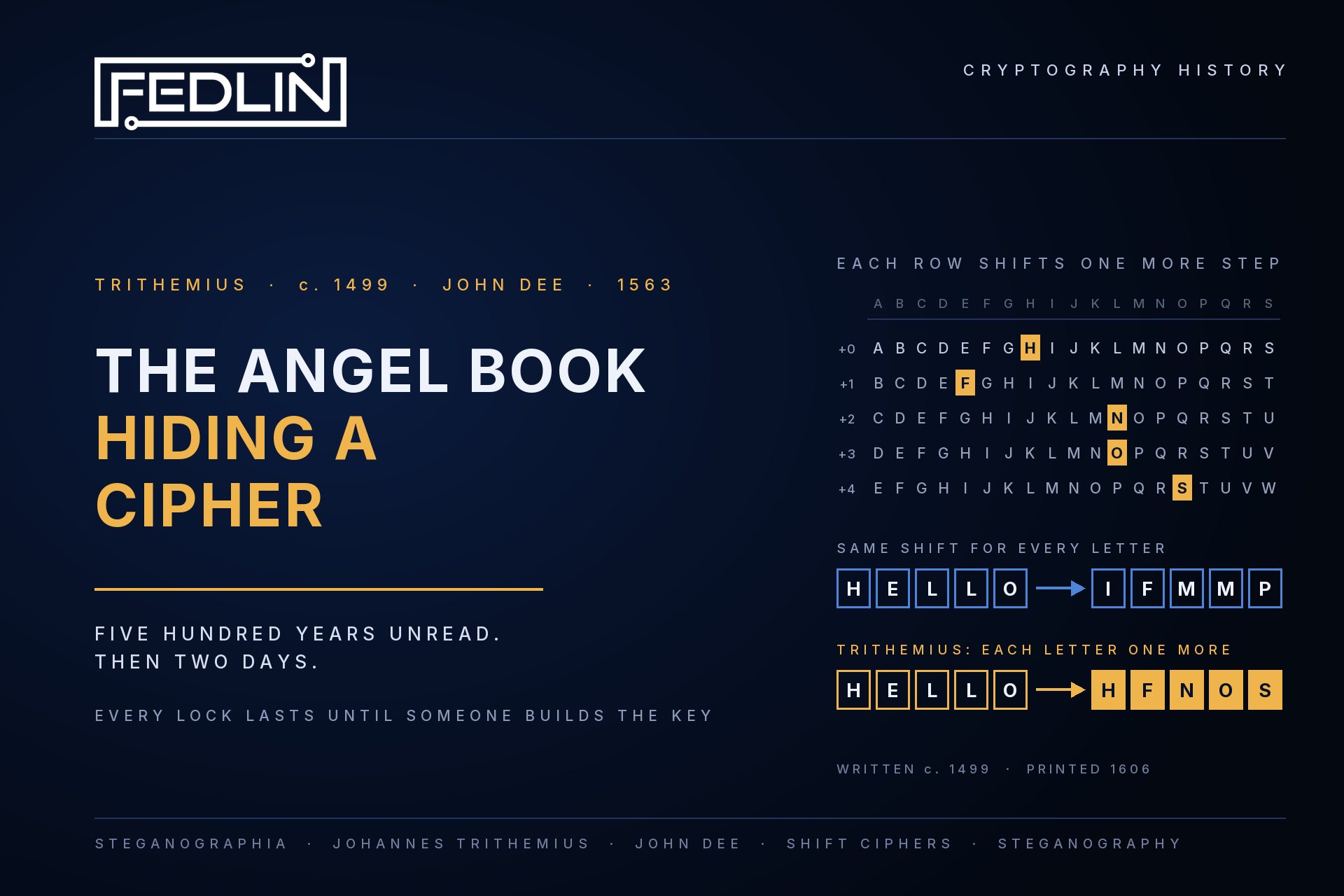
Steganographia: The Angel Book Hiding a Cipher
An abbot hid working codes in a book about angels carrying messages through the air. Five centuries later, the same concept runs through radio, AI, and quantum computers, and may say something about reality itself.
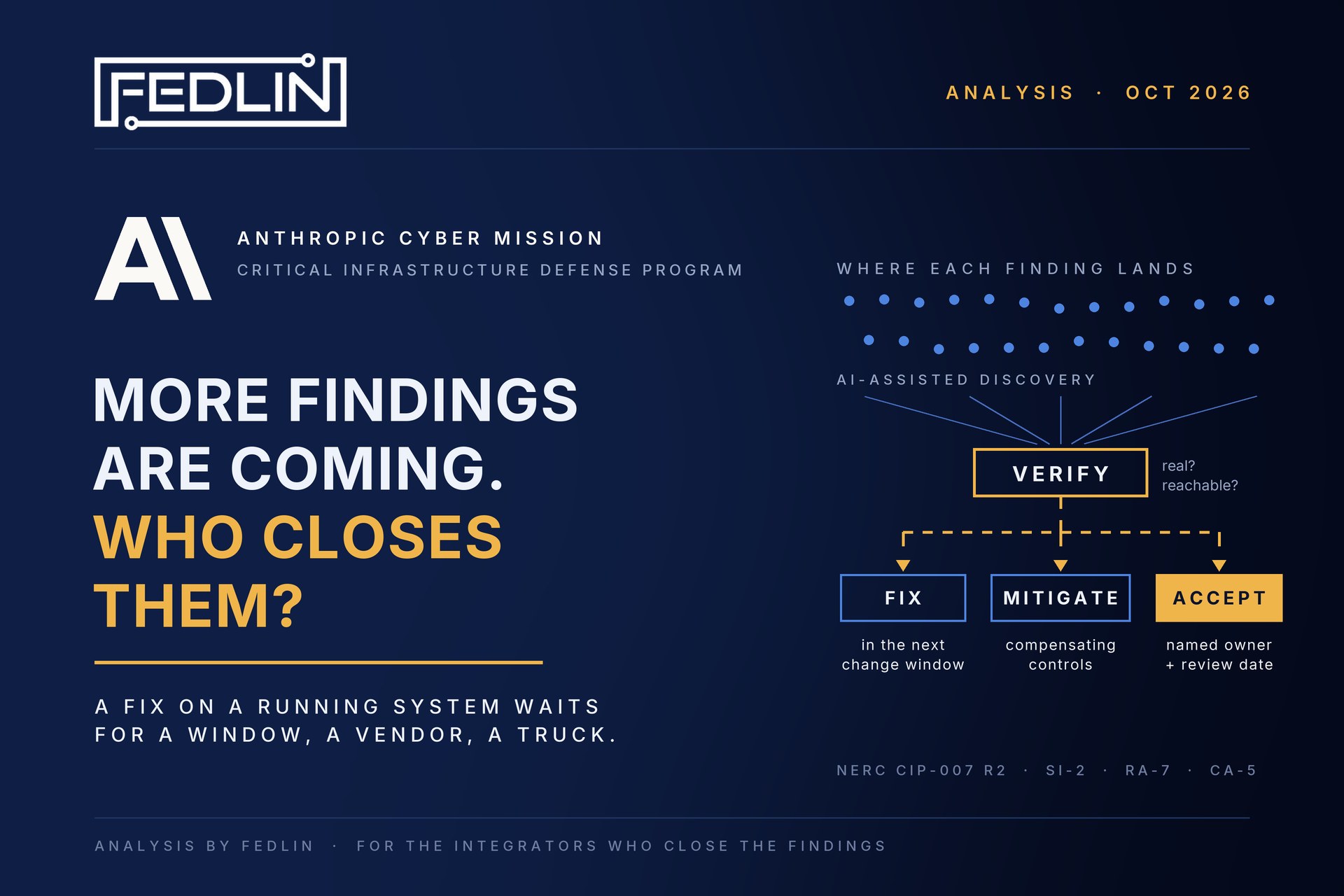
Anthropic's Critical Infrastructure Defense Program and the Remediation Backlog
On October 8, Anthropic launched its Cyber Mission and a program that brings frontier AI to the firms defending power, water, and transportation systems. Your clients are about to see more vulnerabilities, faster. The firms that hold those contracts will need the capacity to fix them, and to document the ones that can't be fixed.
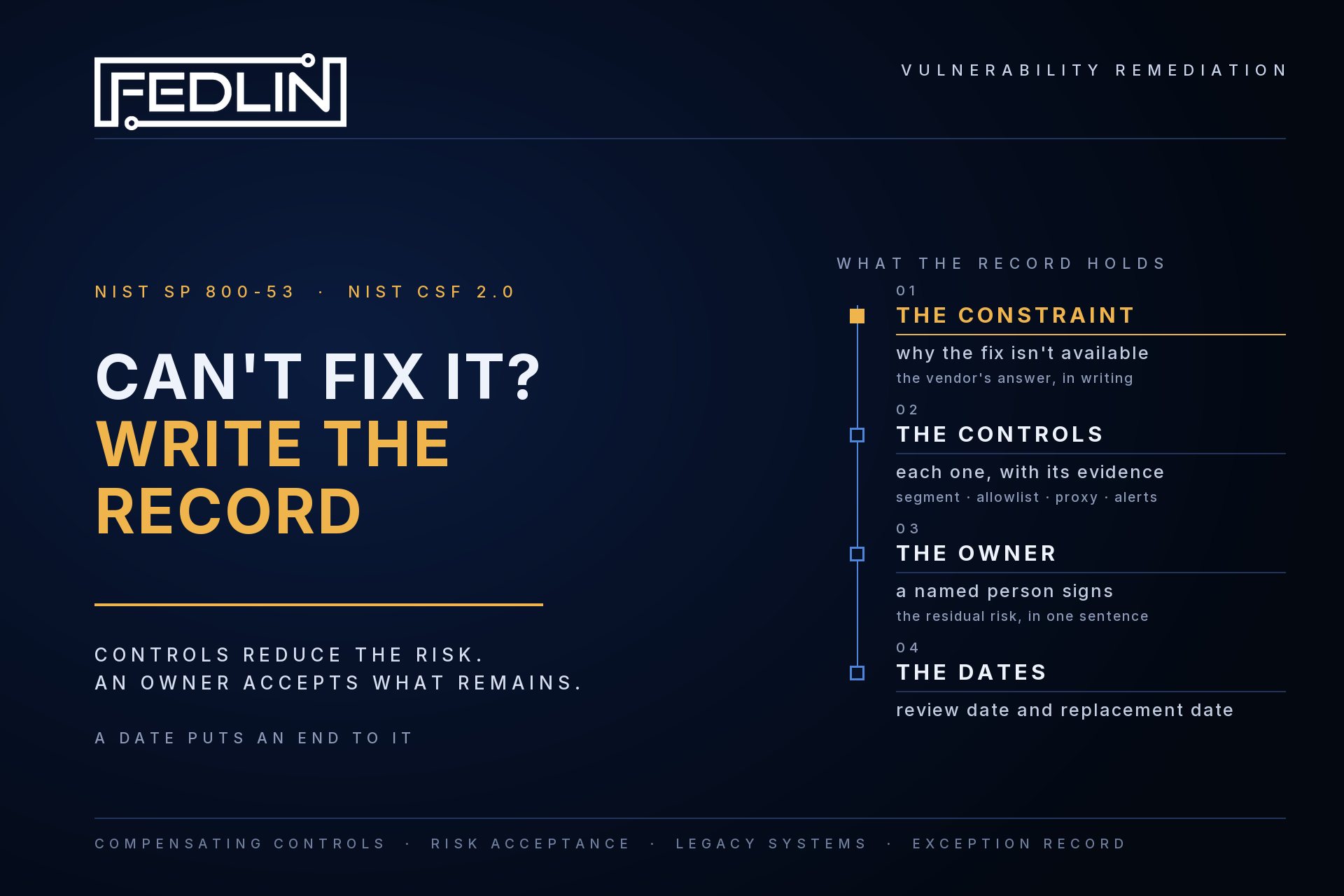
Compensating Controls for Legacy Systems: Accepting Cryptographic Risk With Evidence
A scanner flagged weak encryption on a system you can't change: an old gateway, a terminal, an appliance past vendor support. Here is how to treat the finding, which compensating controls carry weight, and how to write the record an assessor can accept.
Frequently Asked Questions
What does working with FEDLIN look like?
Engagements start with a scoping call about your architecture and the review in front of you: a NERC CIP audit, an encryption or remote-access finding, a customer security review, or a federal contract requirement. From there the work is a build. We measure what your buyer requires, engineer the fixes, and hand you the evidence that clears it.
Does FEDLIN do architecture or engineering?
Both, by design. Every engagement starts with the architecture decision (which controls, where, and why) before anything is built. The design and the build are complementary and can be delivered on their own or together.
We don't have a security team. Can FEDLIN run the whole program?
That's a common place to be as you grow. FEDLIN builds your control program as a scoped project, then keeps it running on a monthly retainer sized to what's at stake: the controls, the evidence wired into your GRC platform, and the program that clears the review and keeps it clear.
What does NERC CIP require when a security patch can't be applied?
CIP-007 R2 requires you to evaluate released security patches for applicability at least once every 35 calendar days. For each applicable patch, within 35 days of that evaluation, you apply it, create a dated mitigation plan, or revise an existing one, and then carry out the plan in the timeframe it sets. FEDLIN fixes what the system can take and writes the mitigation and compensating-control records for what it can't, with the evidence your CIP auditor reviews.
Is it safe to use AI tools on OT systems?
It can be, with the controls already used for people and vendors. Joint CISA guidance from December 2025 centers on human oversight of critical decisions and fail-safe design. In practice that means verified people, scoped and logged access for each agent, analysis kept off the control network, and a human approving every change to a running system. That is how FEDLIN works on OT engagements.
What does OMB M-26-15 mean for federal contractors?
OMB M-26-15 directs federal civilian agencies to inventory their cryptography and plan the move to NIST's post-quantum algorithms (ML-KEM, ML-DSA, and SLH-DSA). Contractors feel it through what agencies ask of them: an inventory of the cryptography in the systems you run for them, a migration plan, and post-quantum support written into product and contract requirements. Executive Order 14412 separately directs a proposed FAR rule that would extend NIST's post-quantum standards to covered contractors, so the contractors who build the inventory now are ahead of the FAR rule. FEDLIN produces that inventory for the systems in scope and sequences the migration from it, delivered through your prime or integrator.
How do you secure remote and vendor access into OT?
Every remote and vendor access path into the control network gets mapped, including the cellular and satellite links that backhaul remote sites. For high- and medium-impact BES Cyber Systems, the paths are engineered to NERC CIP-005 R2 and R3: an Intermediate System, encryption and multi-factor authentication on interactive remote access, and the ability to see and end active vendor sessions, with an evidence package your auditor can follow. Paths that can't change get a risk-acceptance record with compensating controls, and work inside an Electronic Security Perimeter runs through your team or integrator.
What's the relationship between NIST CSF and NIST 800-53?
NIST CSF is the framework designed for communication. It gives founders, executives, and non-technical stakeholders a clear language for security posture across five functions: Identify, Protect, Detect, Respond, Recover. NIST 800-53 is the technical control catalog underneath it, the specific controls that implement what CSF describes. FEDLIN assesses and builds to both. Every major framework, including SOC 2 and PCI DSS, maps back to this foundation.
What does principal-led mean in practice?
You work directly with the principal security architect, the person who owns the architecture, the engagement, and the build. Delivery draws on a vetted partner network where scope requires it: penetration testing, specialized infrastructure work, or govtech contracting.
Do you work with integrators, MSPs, or fractional advisors?
Integrators, MSPs, and fractional advisors bring FEDLIN in for the specialist work their clients need and can't keep on staff: cryptographic readiness, OT remote access, vulnerability backlogs on legacy systems, and edge and identity hardening. You keep the client, the relationship, and the advisory lead. FEDLIN does the engineering, findings to you first. See the partner program for how this works.